|
Others being
confirmed ..........
Abbotswood and Norton Junction
--
presented by
Phil Bullock
- 4mm Scale
 After
a number of years, we are delighted to welcome
Phil Bullock back with the new Mark II version
of Abbotswood Junction. Set in the beautiful
South Worcestershire countryside, where the
skylarks sing—except when interrupted by the
passing trains—the layout captures the
atmosphere of the late 1960s and early 1970s.
Steam disappeared from the area around five
years earlier, leaving diesel traction firmly in
command. Diesel-electrics dominate the busy
Birmingham to Gloucester cross-country route,
while Western Region hydraulic locomotives work
services between Worcester and London via
Oxford. There is always something to catch the
eye. Keep an eye out for famous named passenger
trains such as The Cornishman, The Devonian, and
The Cathedrals Express, all running in the
period after headboards had disappeared. You
will also see Motorail services carrying
holidaymakers from the Midlands and the North to
the beaches of Devon and Cornwall, long before
the M5 transformed holiday travel. Freight
traffic is equally varied and authentic, with
block oil trains from South Wales to the
Midlands, coal and steel workings in both
directions, china clay from Cornwall, and an
endless procession of general merchandise
trains. And if you're lucky, a steam locomotive
may make a rare appearance on a special movement
from Ashchurch to an open day in Birmingham. The
layout is fully DCC controlled, featuring
sound-fitted locomotives and working semaphore
signals that add to the realism. Sit back for a
while and enjoy the constant procession of
trains, recreating the sights and sounds of one
of Britain's busiest main lines during the
golden age of first-generation diesel traction. After
a number of years, we are delighted to welcome
Phil Bullock back with the new Mark II version
of Abbotswood Junction. Set in the beautiful
South Worcestershire countryside, where the
skylarks sing—except when interrupted by the
passing trains—the layout captures the
atmosphere of the late 1960s and early 1970s.
Steam disappeared from the area around five
years earlier, leaving diesel traction firmly in
command. Diesel-electrics dominate the busy
Birmingham to Gloucester cross-country route,
while Western Region hydraulic locomotives work
services between Worcester and London via
Oxford. There is always something to catch the
eye. Keep an eye out for famous named passenger
trains such as The Cornishman, The Devonian, and
The Cathedrals Express, all running in the
period after headboards had disappeared. You
will also see Motorail services carrying
holidaymakers from the Midlands and the North to
the beaches of Devon and Cornwall, long before
the M5 transformed holiday travel. Freight
traffic is equally varied and authentic, with
block oil trains from South Wales to the
Midlands, coal and steel workings in both
directions, china clay from Cornwall, and an
endless procession of general merchandise
trains. And if you're lucky, a steam locomotive
may make a rare appearance on a special movement
from Ashchurch to an open day in Birmingham. The
layout is fully DCC controlled, featuring
sound-fitted locomotives and working semaphore
signals that add to the realism. Sit back for a
while and enjoy the constant procession of
trains, recreating the sights and sounds of one
of Britain's busiest main lines during the
golden age of first-generation diesel traction.
Arrowmouth
- presented by
Redditch MRC - 4mm Scale
 Picture
a warm summer's day on the beach. The sea is
calm, the sun is shining, and the only sound is
the gentle wash of the waves. Then, without
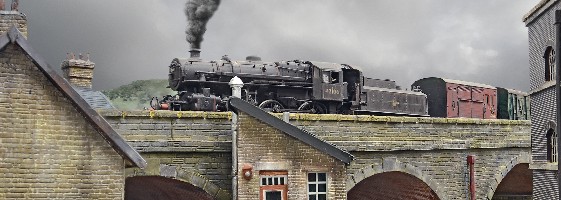
warning, the peace is shattered as a former LMS
Pacific storms past on a northbound express to
Scotland. It is this evocative scene from the
final years of steam that Arrowmouth seeks to
recreate. Set on the north-west coast of
England, Arrowmouth is a fictional seaside town
inspired by the area around Hest Bank, between
Lancaster and Carnforth, on the former London &
North Western Railway main line. The layout
depicts the West Coast Main Line during the
closing years of the steam era, before overhead
electrification advanced north towards Scotland.
The period represented is approximately 1963 to
1968, when steam was enjoying its Indian Summer
in this part of the country. Built to 4 mm scale
using OO gauge track, the layout combines
accurate railway operation with a convincing
coastal setting. Every building has been
scratch-built, using thick card for the basic
structures before being finished with brick
papers, plasticard, or textured sandpaper to
represent brickwork, stone, and the rendered
concrete surfaces so characteristic of many
British seaside towns. Arrowmouth has been
designed as a complete historical scene, where
the trains are just as important as the
landscape. Rather than relying on ready-to-run
stock straight from the box, locomotives and
rolling stock have been carefully detailed,
modified, and marshalled into authentic
formations that faithfully represent trains of
the period. In recent years the layout has
undergone an extensive refurbishment to bring it
in line with the Club's latest exhibition
standards. This has included a completely
remodelled goods yard with a revised track plan,
together with entirely new scenic treatment on
both corners of the layout. The result is a
layout that combines historical authenticity
with high-quality modelling, capturing the
atmosphere of Britain's premier main line during
one of the most fascinating periods in railway
history. Picture
a warm summer's day on the beach. The sea is
calm, the sun is shining, and the only sound is
the gentle wash of the waves. Then, without
warning, the peace is shattered as a former LMS
Pacific storms past on a northbound express to
Scotland. It is this evocative scene from the
final years of steam that Arrowmouth seeks to
recreate. Set on the north-west coast of
England, Arrowmouth is a fictional seaside town
inspired by the area around Hest Bank, between
Lancaster and Carnforth, on the former London &
North Western Railway main line. The layout
depicts the West Coast Main Line during the
closing years of the steam era, before overhead
electrification advanced north towards Scotland.
The period represented is approximately 1963 to
1968, when steam was enjoying its Indian Summer
in this part of the country. Built to 4 mm scale
using OO gauge track, the layout combines
accurate railway operation with a convincing
coastal setting. Every building has been
scratch-built, using thick card for the basic
structures before being finished with brick
papers, plasticard, or textured sandpaper to
represent brickwork, stone, and the rendered
concrete surfaces so characteristic of many
British seaside towns. Arrowmouth has been
designed as a complete historical scene, where
the trains are just as important as the
landscape. Rather than relying on ready-to-run
stock straight from the box, locomotives and
rolling stock have been carefully detailed,
modified, and marshalled into authentic
formations that faithfully represent trains of
the period. In recent years the layout has
undergone an extensive refurbishment to bring it
in line with the Club's latest exhibition
standards. This has included a completely
remodelled goods yard with a revised track plan,
together with entirely new scenic treatment on
both corners of the layout. The result is a
layout that combines historical authenticity
with high-quality modelling, capturing the
atmosphere of Britain's premier main line during
one of the most fascinating periods in railway
history.
Bazil Radford
- presented by
Dave Maries and
Tyler Campbell - 4mm Scale
 For
our 60th Anniversary show we welcome David
Maries who is the eldest son of founder member
John Maries. Situated on the north-eastern
county boundary of Avonvale is the small market
town of Bazil Radford. Its station was built by
the Great Western Railway to serve the growing
number of fruit and vegetable producers in the
surrounding area, providing them with a rail
link to the docks and the larger towns and
cities beyond. The valuable freight service has
also encouraged a modest increase in passenger
traffic, with local residents using the railway
to commute to the larger towns of Avonvale and
the surrounding counties. Services are operated
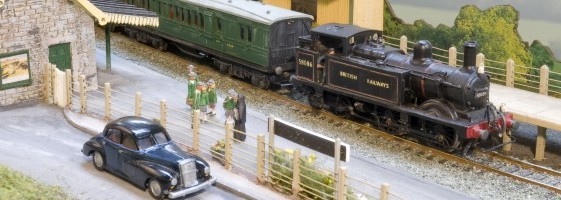
by a mixture of Great Western Railway small tank
and tender locomotives. The model depicts Bazil
Radford during the 1930s. The county of Avonvale
is entirely fictional, while all the buildings
on the layout have been scratch-built using
cardboard, paper, plastic and clay. The
trackwork is Peco, powered by a 12-volt
Gaugemaster analogue control system. For
our 60th Anniversary show we welcome David
Maries who is the eldest son of founder member
John Maries. Situated on the north-eastern
county boundary of Avonvale is the small market
town of Bazil Radford. Its station was built by
the Great Western Railway to serve the growing
number of fruit and vegetable producers in the
surrounding area, providing them with a rail
link to the docks and the larger towns and
cities beyond. The valuable freight service has
also encouraged a modest increase in passenger
traffic, with local residents using the railway
to commute to the larger towns of Avonvale and
the surrounding counties. Services are operated
by a mixture of Great Western Railway small tank
and tender locomotives. The model depicts Bazil
Radford during the 1930s. The county of Avonvale
is entirely fictional, while all the buildings
on the layout have been scratch-built using
cardboard, paper, plastic and clay. The
trackwork is Peco, powered by a 12-volt
Gaugemaster analogue control system.
Brades
- presented by
Warley MRC - 2mm Scale
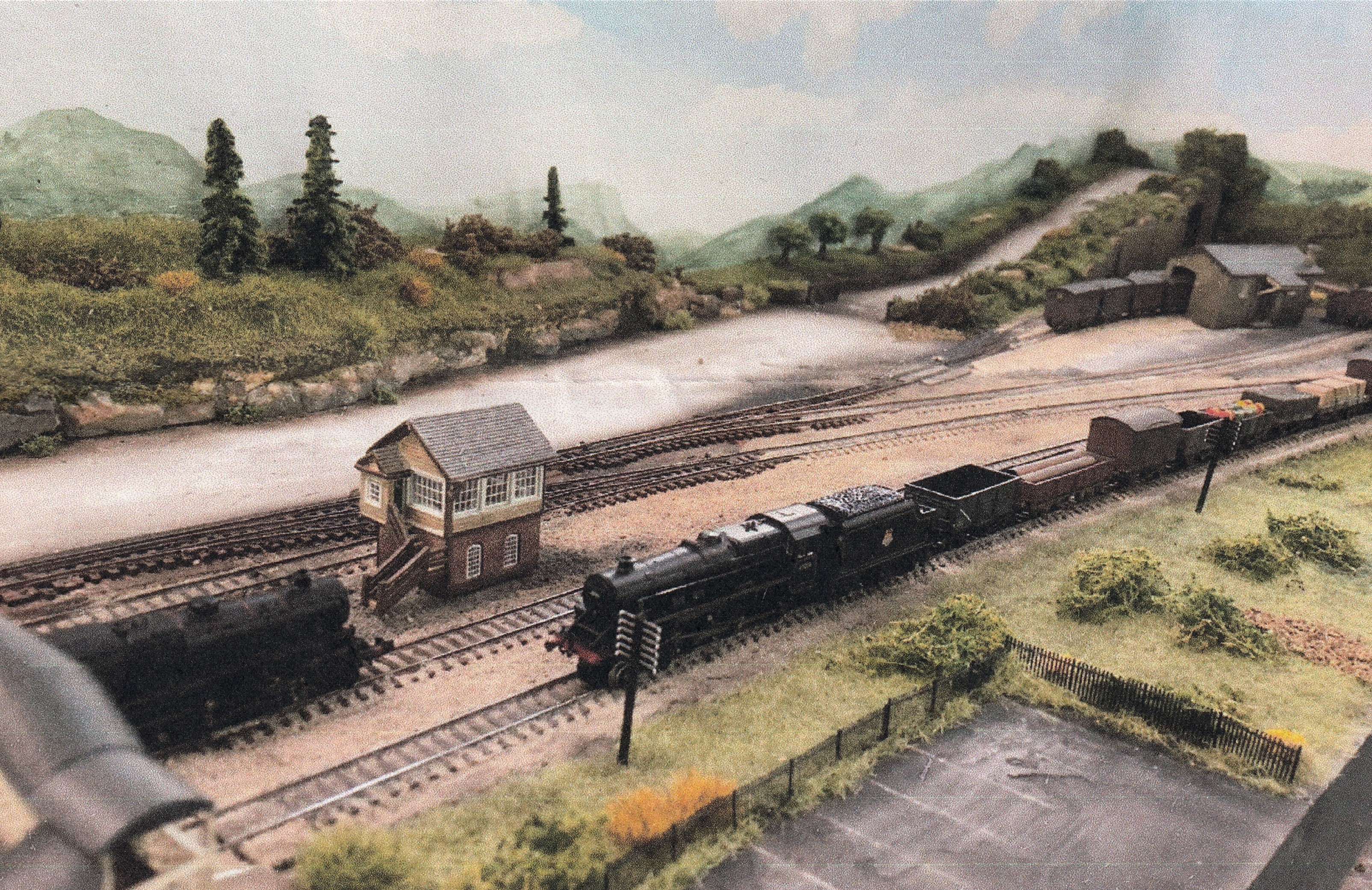 For
our 60th Anniversary show we welcome Warley
MRC who became the first visiting model
railway club to bring a layout to our show
which was in 1971. Brades is a fictitious rural
village served by a small, remote country
station. The layout is set during the transition
from the steam era to the early days of diesel
traction, providing an opportunity to portray a
typical rural railway scene from this changing
period. The station is served by a two-track
main line, with a small goods yard and a
substantial stone-built engine shed adding
interest to the railway scene. The station
itself has two platforms. The main station
building stands on one platform, which also
incorporates a bay platform, while the opposite
platform is formed as an island. Brades has
evolved considerably from its original concept.
The layout was initially conceived as an
industrial scene, but this idea was later
changed in favour of the more rural setting that
can be seen today. A mixture of plaster, foam,
plaster bandage and Woodland Scenics products
has been used to create the landscape, giving
the village and railway a suitably natural
setting. Considerable work has also gone into
the layout's operation. The original wiring was
largely replaced and simplified, making the
layout more reliable and easier to operate.
Brades remains entirely analogue, using
conventional DC control with three controllers
to operate the various sections of the
railway. At approximately 2.6 metres in length,
Brades demonstrates how a compact layout can
combine a rural station, goods facilities and
locomotive servicing arrangements to create an
interesting and operational railway scene. For
our 60th Anniversary show we welcome Warley
MRC who became the first visiting model
railway club to bring a layout to our show
which was in 1971. Brades is a fictitious rural
village served by a small, remote country
station. The layout is set during the transition
from the steam era to the early days of diesel
traction, providing an opportunity to portray a
typical rural railway scene from this changing
period. The station is served by a two-track
main line, with a small goods yard and a
substantial stone-built engine shed adding
interest to the railway scene. The station
itself has two platforms. The main station
building stands on one platform, which also
incorporates a bay platform, while the opposite
platform is formed as an island. Brades has
evolved considerably from its original concept.
The layout was initially conceived as an
industrial scene, but this idea was later
changed in favour of the more rural setting that
can be seen today. A mixture of plaster, foam,
plaster bandage and Woodland Scenics products
has been used to create the landscape, giving
the village and railway a suitably natural
setting. Considerable work has also gone into
the layout's operation. The original wiring was
largely replaced and simplified, making the
layout more reliable and easier to operate.
Brades remains entirely analogue, using
conventional DC control with three controllers
to operate the various sections of the
railway. At approximately 2.6 metres in length,
Brades demonstrates how a compact layout can
combine a rural station, goods facilities and
locomotive servicing arrangements to create an
interesting and operational railway scene.
Chilcompton
- presented by
Redditch MRC - 4mm Scale
 This
year's exhibition of Chilcompton is dedicated to
the memory of Mick Clements, our Club President
and one of the founding members of the Redditch
Model Railway Club, who sadly passed away in
June 2026. Mick was instrumental in the design
and construction of this layout and, indeed, in
many of the Club's Somerset & Dorset projects
over the years. It is therefore a fitting
tribute that a layout to which he devoted so
much time, skill and enthusiasm should once
again be on public display. Chilcompton is the
latest in a series of Somerset & Dorset Joint
Railway exhibition layouts produced by the Club.
It is based on the prototype station of the same
name, situated on the S&DJR main line between
Midsomer Norton and Evercreech Junction. The
layout portrays the station during the early
British Railways era, between 1950 and 1955,
with every locomotive, carriage and wagon chosen
to reflect the traffic that would genuinely have
been seen on the line during this period. Built
to 4 mm scale using OO gauge track, the station
and goods yard have been reproduced to scale as
faithfully as possible. Inevitably, a small
amount of artistic licence has been employed at
each end of the layout to curve the running
lines into the concealed fiddle yard, allowing
reliable exhibition operation while preserving
the appearance of the prototype. Behind the
scenes, a sixteen-road fiddle yard is capable of
accommodating up to twenty-four complete trains,
enabling an authentic sequence of passenger and
freight services throughout the day. Every
building on the layout has been scratch-built,
using thick card for the main structures before
being clad with plasticard to reproduce the
distinctive stone and brick architecture of the
Somerset & Dorset. Combined with carefully
researched rolling stock and operation, the
result is a faithful representation of one of
Britain's most celebrated rural main lines
during the twilight years of steam. More than
simply a model railway, Chilcompton stands as a
lasting reminder of Mick Clements'
craftsmanship, dedication and passion for both
the Somerset & Dorset Joint Railway and the
Redditch Model Railway Club. We hope you enjoy
watching the layout as much as Mick enjoyed
helping to create it. The era is set sometime between 1950
and 1955 and all the stock used represents what
would actually have run over the real line at
this time. The scale is 4mm using "OO" gauge
track. The whole of the station and goods yard
area is modelled to scale. However some artistic licence has had to be taken so as to curve the
track formation at each end into the fiddle
yard. The fiddle yard features sixteen roads and
is capable of holding 24 separate trains. All
the buildings on the layout are scratch built,
mainly using thick card for the basic structure.
These are covered with plasticard to represent
stone or brick finishes. This
year's exhibition of Chilcompton is dedicated to
the memory of Mick Clements, our Club President
and one of the founding members of the Redditch
Model Railway Club, who sadly passed away in
June 2026. Mick was instrumental in the design
and construction of this layout and, indeed, in
many of the Club's Somerset & Dorset projects
over the years. It is therefore a fitting
tribute that a layout to which he devoted so
much time, skill and enthusiasm should once
again be on public display. Chilcompton is the
latest in a series of Somerset & Dorset Joint
Railway exhibition layouts produced by the Club.
It is based on the prototype station of the same
name, situated on the S&DJR main line between
Midsomer Norton and Evercreech Junction. The
layout portrays the station during the early
British Railways era, between 1950 and 1955,
with every locomotive, carriage and wagon chosen
to reflect the traffic that would genuinely have
been seen on the line during this period. Built
to 4 mm scale using OO gauge track, the station
and goods yard have been reproduced to scale as
faithfully as possible. Inevitably, a small
amount of artistic licence has been employed at
each end of the layout to curve the running
lines into the concealed fiddle yard, allowing
reliable exhibition operation while preserving
the appearance of the prototype. Behind the
scenes, a sixteen-road fiddle yard is capable of
accommodating up to twenty-four complete trains,
enabling an authentic sequence of passenger and
freight services throughout the day. Every
building on the layout has been scratch-built,
using thick card for the main structures before
being clad with plasticard to reproduce the
distinctive stone and brick architecture of the
Somerset & Dorset. Combined with carefully
researched rolling stock and operation, the
result is a faithful representation of one of
Britain's most celebrated rural main lines
during the twilight years of steam. More than
simply a model railway, Chilcompton stands as a
lasting reminder of Mick Clements'
craftsmanship, dedication and passion for both
the Somerset & Dorset Joint Railway and the
Redditch Model Railway Club. We hope you enjoy
watching the layout as much as Mick enjoyed
helping to create it. The era is set sometime between 1950
and 1955 and all the stock used represents what
would actually have run over the real line at
this time. The scale is 4mm using "OO" gauge
track. The whole of the station and goods yard
area is modelled to scale. However some artistic licence has had to be taken so as to curve the
track formation at each end into the fiddle
yard. The fiddle yard features sixteen roads and
is capable of holding 24 separate trains. All
the buildings on the layout are scratch built,
mainly using thick card for the basic structure.
These are covered with plasticard to represent
stone or brick finishes.
Daisy Lane TMD
- presented by
Simon Lemmon
-
4mm Scale
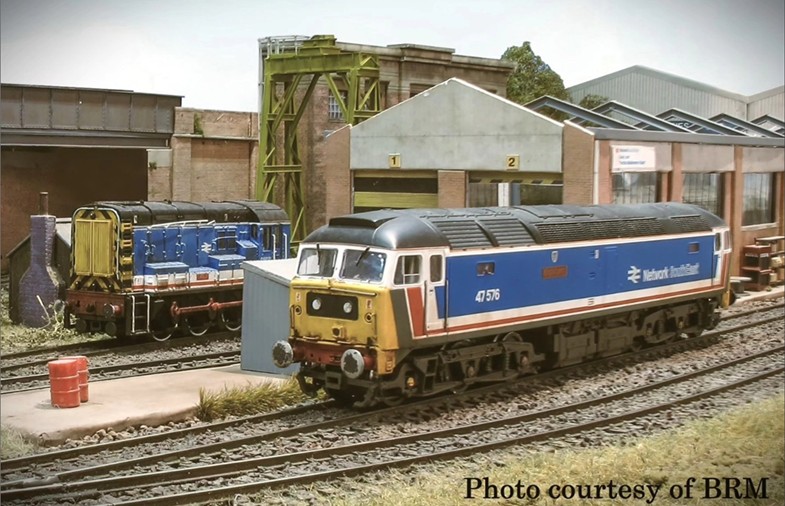 The
distinctive growl of Sulzer, English Electric
and Ruston engines fills the air as another
locomotive eases into the depot. Fuel tanks are
replenished, routine maintenance is carried out
and crews sign on for their next turn of duty
before the locomotives once again head out onto
the network. Daisy Lane TMD captures the
atmosphere of a busy diesel depot during the
final years of British Rail. Set in East Anglia
during the late 1980s and early 1990s, the
layout represents a typical Traction Maintenance
Depot providing refuelling facilities,
locomotive servicing, crew signing-on and
stabling. Although fictional, Daisy Lane
reflects the appearance and day-to-day operation
of the many depots that kept Britain's diesel
fleet moving during this fascinating period of
railway history. The depot plays host to an
impressive variety of motive power, with Classes
08, 20, 31, 37, 45, 47, 50, 56 and 60 all making
appearances throughout the day. The locomotives
carry a colourful selection of liveries,
including classic British Rail Blue, Railfreight,
Network SouthEast and several special one-off
schemes, illustrating the changing face of
British Rail as the sectorisation era gave way
to privatisation. Most of the locomotives are
ready-to-run models produced by Bachmann, Hornby
and Heljan, complemented by a number of
carefully modified Lima models that continue to
earn their place alongside more modern releases.
To recreate the hard-working appearance of the
period, the majority of the fleet has been
weathered using a variety of techniques,
capturing the grime, oil stains and general wear
that were such familiar features of Britain's
railways at the time. The layout is operated
using Digital Command Control (DCC), with a
number of locomotives fitted with sound
decoders, adding another dimension to the
operation. The combination of authentic
locomotive movements, realistic weathering and
the unmistakable sounds of first-generation and
second-generation diesel traction helps bring
Daisy Lane TMD to life, recreating the
atmosphere of a busy British Rail depot at the
close of the 1980s. The
distinctive growl of Sulzer, English Electric
and Ruston engines fills the air as another
locomotive eases into the depot. Fuel tanks are
replenished, routine maintenance is carried out
and crews sign on for their next turn of duty
before the locomotives once again head out onto
the network. Daisy Lane TMD captures the
atmosphere of a busy diesel depot during the
final years of British Rail. Set in East Anglia
during the late 1980s and early 1990s, the
layout represents a typical Traction Maintenance
Depot providing refuelling facilities,
locomotive servicing, crew signing-on and
stabling. Although fictional, Daisy Lane
reflects the appearance and day-to-day operation
of the many depots that kept Britain's diesel
fleet moving during this fascinating period of
railway history. The depot plays host to an
impressive variety of motive power, with Classes
08, 20, 31, 37, 45, 47, 50, 56 and 60 all making
appearances throughout the day. The locomotives
carry a colourful selection of liveries,
including classic British Rail Blue, Railfreight,
Network SouthEast and several special one-off
schemes, illustrating the changing face of
British Rail as the sectorisation era gave way
to privatisation. Most of the locomotives are
ready-to-run models produced by Bachmann, Hornby
and Heljan, complemented by a number of
carefully modified Lima models that continue to
earn their place alongside more modern releases.
To recreate the hard-working appearance of the
period, the majority of the fleet has been
weathered using a variety of techniques,
capturing the grime, oil stains and general wear
that were such familiar features of Britain's
railways at the time. The layout is operated
using Digital Command Control (DCC), with a
number of locomotives fitted with sound
decoders, adding another dimension to the
operation. The combination of authentic
locomotive movements, realistic weathering and
the unmistakable sounds of first-generation and
second-generation diesel traction helps bring
Daisy Lane TMD to life, recreating the
atmosphere of a busy British Rail depot at the
close of the 1980s.
Lob Ghyll
- presented by Tom Couling
- 4mm Scale
 Nestling
amongst the rolling hills of the Yorkshire
Dales, Lob Ghyll takes its name from the
steep-sided ravine carved over countless
centuries by a tumbling beck as it cut
through the soft shale on its journey to
join the River Wharfe near Bolton Abbey. It
is a peaceful rural setting, where the
arrival of a train briefly interrupts the
silence before the landscape once again
returns to tranquillity. The layout imagines
an alternative chapter in railway history.
Following many unsuccessful proposals to
build a railway through Wharfedale, the
Midland Railway and the North Eastern
Railway eventually agreed to construct a
joint line to Ilkley. In this fictional
extension of history, the Midland Railway
continued its ambitions, extending the route
northwards to connect with the Lancashire &
Yorkshire Railway at Skipton, providing a
further link to the famous Settle & Carlisle
line and the route to Scotland. Built to OO
fine-scale standards, Lob Ghyll portrays a
small rural station serving this imagined
Yorkshire Dales main line during the British
Railways steam era. Although fictional, the
railway is firmly rooted in the character
and operating practices of the region,
allowing a varied selection of passenger and
freight traffic to pass through the station.
The scenic setting is an important feature
of the layout. The station buildings,
railway structures and many of the lineside
details have been scratch-built, creating a
distinctive Yorkshire atmosphere that
reflects the stone-built architecture and
rugged beauty of the Dales. Careful
attention to detail throughout the layout
helps recreate the character of a remote
country railway in the years when steam
still dominated Britain's railways. Lob
Ghyll combines a believable "what if?"
railway history with authentic operation and
finely crafted modelling, inviting visitors
to imagine a Yorkshire Dales route that
might so easily have become part of
Britain's railway network Nestling
amongst the rolling hills of the Yorkshire
Dales, Lob Ghyll takes its name from the
steep-sided ravine carved over countless
centuries by a tumbling beck as it cut
through the soft shale on its journey to
join the River Wharfe near Bolton Abbey. It
is a peaceful rural setting, where the
arrival of a train briefly interrupts the
silence before the landscape once again
returns to tranquillity. The layout imagines
an alternative chapter in railway history.
Following many unsuccessful proposals to
build a railway through Wharfedale, the
Midland Railway and the North Eastern
Railway eventually agreed to construct a
joint line to Ilkley. In this fictional
extension of history, the Midland Railway
continued its ambitions, extending the route
northwards to connect with the Lancashire &
Yorkshire Railway at Skipton, providing a
further link to the famous Settle & Carlisle
line and the route to Scotland. Built to OO
fine-scale standards, Lob Ghyll portrays a
small rural station serving this imagined
Yorkshire Dales main line during the British
Railways steam era. Although fictional, the
railway is firmly rooted in the character
and operating practices of the region,
allowing a varied selection of passenger and
freight traffic to pass through the station.
The scenic setting is an important feature
of the layout. The station buildings,
railway structures and many of the lineside
details have been scratch-built, creating a
distinctive Yorkshire atmosphere that
reflects the stone-built architecture and
rugged beauty of the Dales. Careful
attention to detail throughout the layout
helps recreate the character of a remote
country railway in the years when steam
still dominated Britain's railways. Lob
Ghyll combines a believable "what if?"
railway history with authentic operation and
finely crafted modelling, inviting visitors
to imagine a Yorkshire Dales route that
might so easily have become part of
Britain's railway network
Moors View
- presented by
Paul Holwill -
2mm Scale
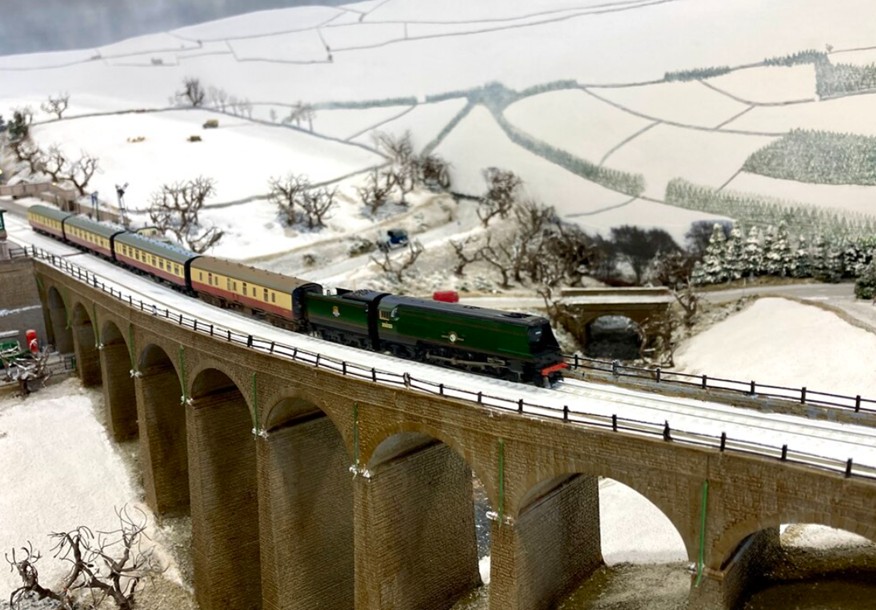 High
on the northern edge of Dartmoor, the peaceful
silence of the countryside is interrupted by the
distant sound of an approaching train. Moments
later, the tranquillity is broken as an express
sweeps across the graceful nine-arched viaduct
before slowing for the small country station at
Moors View. Whether hauled by a Southern steam
locomotive, a gleaming Warship or Western, or
one of the later generations of diesel power,
the railway remains the lifeline through this
spectacular landscape. Moors View is a fictional
N gauge layout set on the former London & South
Western Railway main line between Exeter and
Plymouth, on the stretch between Okehampton and
Tavistock. Nestling beneath the northern slopes
of Dartmoor, the layout depicts a quiet rural
station on a double-track main line, dominated
by its impressive, curved stone viaduct. The
story behind the layout imagines that the route
never suffered the closures of the 1960s and has
remained an important secondary main line. In
this alternative history, the line comes into
its own whenever severe weather damages the sea
wall at Dawlish, providing a vital diversionary
route for passenger and freight services between
Devon and Cornwall. Built to N gauge, the layout
captures the atmosphere of railways crossing the
dramatic West Country landscape, with carefully
modelled scenery complementing realistic railway
operation. Although centred on a fictional
location, every effort has been made to ensure
that the trains, infrastructure and operation
remain faithful to the character of the former
Southern Region. One of the layout's greatest
attractions is the variety of motive power. With
more than thirty different prototype locomotives
represented, Moors View spans almost four
decades of railway history, from the twilight
years of Southern steam in the mid-1950s,
through the diesel-hydraulic era of the Western
Region, and into the early 1990s under British
Rail. This allows visitors to enjoy an
ever-changing procession of trains while
remaining true to the operating practices of
each period. Combining the rugged beauty of
Dartmoor with the romance of Britain's railways,
Moors View offers a glimpse of what might have
been—a West Country main line that continued to
thrive, carrying everything from rural stopping
trains to diverted expresses across one of
England's most dramatic landscapes. High
on the northern edge of Dartmoor, the peaceful
silence of the countryside is interrupted by the
distant sound of an approaching train. Moments
later, the tranquillity is broken as an express
sweeps across the graceful nine-arched viaduct
before slowing for the small country station at
Moors View. Whether hauled by a Southern steam
locomotive, a gleaming Warship or Western, or
one of the later generations of diesel power,
the railway remains the lifeline through this
spectacular landscape. Moors View is a fictional
N gauge layout set on the former London & South
Western Railway main line between Exeter and
Plymouth, on the stretch between Okehampton and
Tavistock. Nestling beneath the northern slopes
of Dartmoor, the layout depicts a quiet rural
station on a double-track main line, dominated
by its impressive, curved stone viaduct. The
story behind the layout imagines that the route
never suffered the closures of the 1960s and has
remained an important secondary main line. In
this alternative history, the line comes into
its own whenever severe weather damages the sea
wall at Dawlish, providing a vital diversionary
route for passenger and freight services between
Devon and Cornwall. Built to N gauge, the layout
captures the atmosphere of railways crossing the
dramatic West Country landscape, with carefully
modelled scenery complementing realistic railway
operation. Although centred on a fictional
location, every effort has been made to ensure
that the trains, infrastructure and operation
remain faithful to the character of the former
Southern Region. One of the layout's greatest
attractions is the variety of motive power. With
more than thirty different prototype locomotives
represented, Moors View spans almost four
decades of railway history, from the twilight
years of Southern steam in the mid-1950s,
through the diesel-hydraulic era of the Western
Region, and into the early 1990s under British
Rail. This allows visitors to enjoy an
ever-changing procession of trains while
remaining true to the operating practices of
each period. Combining the rugged beauty of
Dartmoor with the romance of Britain's railways,
Moors View offers a glimpse of what might have
been—a West Country main line that continued to
thrive, carrying everything from rural stopping
trains to diverted expresses across one of
England's most dramatic landscapes.
Motley Sub Shed
- presented by
Rob Newman - 7mm Scale
 Every
locomotive needs somewhere to wait between
duties. Before taking charge of its next
train, there are fires to clean, tenders to
replenish, and crews to prepare. Motley
captures just such a moment in the daily
life of a small locomotive sub-shed, where
engines pause briefly before returning to
the main line. Built to 7 mm/ft scale (O
gauge), the layout occupies a modest
footprint of approximately 10 ft by 2 ft.
Although compact, its real purpose is not
the track plan or the buildings, but the
locomotives themselves. The collection has
previously been described as something of a
"motley" assortment, making the choice of
name for the layout an obvious one. Rather
than portraying a major motive power depot,
Motley represents a small sub-shed where
locomotives are stabled between workings.
Here they can be serviced, watered and
coaled, while the firebars are cleaned of
clinker before the next call to duty. This
simple setting provides an ideal stage on
which to display a wide variety of
locomotives in a realistic railway
environment. During the course of an
exhibition, locomotives are regularly
exchanged, allowing visitors to enjoy an
ever-changing selection of models. The
collection ranges from British Railways
steam locomotives from the Scottish, London
Midland and Western Regions—with the
occasional Southern Region visitor—to
industrial locomotives and first-generation
diesel classes from the classic green era.
Whether displayed as regionally accurate
fleets or as a mixed collection, the
emphasis is always on showcasing fine
locomotive modelling. Most of the
locomotives and many of the scenic details
have been hand-built from kits. The Club is
particularly grateful to Keith Blake, Aidan
Houlders and others whose skill and
craftsmanship have contributed so much to
the collection. Motley also serves an
important role in promoting the work of The
Stanier 8F Locomotive Society Ltd., owners
of Stanier 8F No. 48773 (formerly LMS No.
8233 and WD307). The locomotive is currently
awaiting overhaul and is on display in the
Engine House at Highley on the Severn Valley
Railway. If you would like to know more
about the locomotive, the Society, or how
you can become a member and support the
restoration of this historic engine, please
speak to one of the layout operators, who
will be delighted to help. Every
locomotive needs somewhere to wait between
duties. Before taking charge of its next
train, there are fires to clean, tenders to
replenish, and crews to prepare. Motley
captures just such a moment in the daily
life of a small locomotive sub-shed, where
engines pause briefly before returning to
the main line. Built to 7 mm/ft scale (O
gauge), the layout occupies a modest
footprint of approximately 10 ft by 2 ft.
Although compact, its real purpose is not
the track plan or the buildings, but the
locomotives themselves. The collection has
previously been described as something of a
"motley" assortment, making the choice of
name for the layout an obvious one. Rather
than portraying a major motive power depot,
Motley represents a small sub-shed where
locomotives are stabled between workings.
Here they can be serviced, watered and
coaled, while the firebars are cleaned of
clinker before the next call to duty. This
simple setting provides an ideal stage on
which to display a wide variety of
locomotives in a realistic railway
environment. During the course of an
exhibition, locomotives are regularly
exchanged, allowing visitors to enjoy an
ever-changing selection of models. The
collection ranges from British Railways
steam locomotives from the Scottish, London
Midland and Western Regions—with the
occasional Southern Region visitor—to
industrial locomotives and first-generation
diesel classes from the classic green era.
Whether displayed as regionally accurate
fleets or as a mixed collection, the
emphasis is always on showcasing fine
locomotive modelling. Most of the
locomotives and many of the scenic details
have been hand-built from kits. The Club is
particularly grateful to Keith Blake, Aidan
Houlders and others whose skill and
craftsmanship have contributed so much to
the collection. Motley also serves an
important role in promoting the work of The
Stanier 8F Locomotive Society Ltd., owners
of Stanier 8F No. 48773 (formerly LMS No.
8233 and WD307). The locomotive is currently
awaiting overhaul and is on display in the
Engine House at Highley on the Severn Valley
Railway. If you would like to know more
about the locomotive, the Society, or how
you can become a member and support the
restoration of this historic engine, please
speak to one of the layout operators, who
will be delighted to help.
Newchapel Junction
- presented by
Newchapel
Junction Group - 7mm Scale
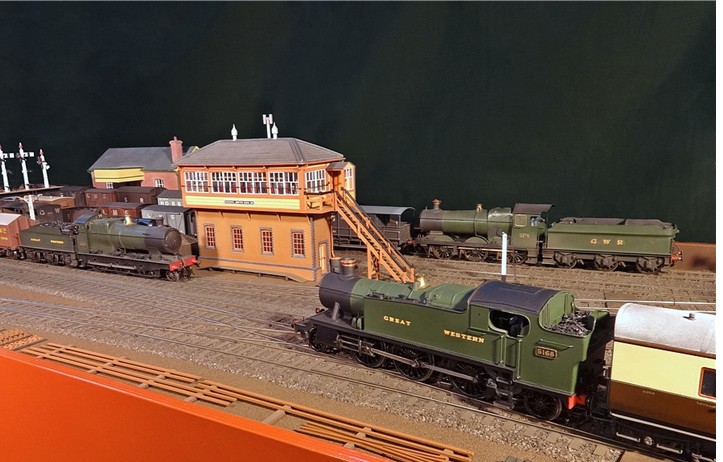 Newchapel
Junction is a finescale O gauge layout set
during the post-Grouping period, somewhere
in the Yeovil area where the Southern
Railway and the Great Western Railway ran
side by side. The layout captures the
atmosphere of a busy railway in its heyday,
with a constant procession of passenger and
freight traffic serving the impressive
terminus station at Newchapel Junction. The
motive power ranges from main line express
passenger locomotives and heavy freight
engines to smaller branch line tank
locomotives from both the Southern Railway
and the Great Western Railway. Passenger
services, together with parcels and van
trains, depart from the terminus before
circling the layout and returning, allowing
the locomotives to be turned and run round
their trains in preparation for the next
departure. Freight traffic plays an equally
important role. Trains leave the extensive
goods yard at Newchapel Town, complete a
circuit of the layout and return for
remarshalling. Continuous shunting
operations ensure that each freight train
exchanges numerous wagons before setting off
on its next journey, providing plenty of
realistic railway activity throughout an
operating session. The layout is operated
from four control panels and is fully
semaphore signalled. Train movements between
Newchapel Junction station and the running
circuits are controlled by traditional block
instruments, which also transmit train
descriptions between operators. All signals
and points are fully interlocked, while
those within the station area are controlled
by a relay-operated push-button
entrance-exit panel, accurately recreating
the operation of a busy main line terminus.
For more information about the layout,
please visit www.newchapeljn.co.uk. Newchapel
Junction is a finescale O gauge layout set
during the post-Grouping period, somewhere
in the Yeovil area where the Southern
Railway and the Great Western Railway ran
side by side. The layout captures the
atmosphere of a busy railway in its heyday,
with a constant procession of passenger and
freight traffic serving the impressive
terminus station at Newchapel Junction. The
motive power ranges from main line express
passenger locomotives and heavy freight
engines to smaller branch line tank
locomotives from both the Southern Railway
and the Great Western Railway. Passenger
services, together with parcels and van
trains, depart from the terminus before
circling the layout and returning, allowing
the locomotives to be turned and run round
their trains in preparation for the next
departure. Freight traffic plays an equally
important role. Trains leave the extensive
goods yard at Newchapel Town, complete a
circuit of the layout and return for
remarshalling. Continuous shunting
operations ensure that each freight train
exchanges numerous wagons before setting off
on its next journey, providing plenty of
realistic railway activity throughout an
operating session. The layout is operated
from four control panels and is fully
semaphore signalled. Train movements between
Newchapel Junction station and the running
circuits are controlled by traditional block
instruments, which also transmit train
descriptions between operators. All signals
and points are fully interlocked, while
those within the station area are controlled
by a relay-operated push-button
entrance-exit panel, accurately recreating
the operation of a busy main line terminus.
For more information about the layout,
please visit www.newchapeljn.co.uk.
Pen- y-bont Fawr
- presented by
Steve Monk -
4mm Scale
 Pen-
y-bont fawr is a small town situated in the
Tanat Valley in mid-Wales. The original
railway line was built primarily to
transport stone and minerals, including
granite and lead ore from the lead mines at
Llangynog, to Oswestry and beyond. The
layout is loosely based on the station and
small goods yard at Pen- y-bont fawr but
represents a “might-have-been” scenario in
which the railway was developed further
following its acquisition by the Great
Western Railway after the Grouping of 1923.
In this alternative history, it is assumed
that the section of line between Pen- y-bont
fawr and Llangynog had eventually closed
following severe flooding and a series of
landslips affecting the railway to the west
of Pen- y-bont fawr. The surviving section
was subsequently developed by the GWR,
resulting in the enlarged station and
facilities depicted on the model. The layout
was built during 2018–19, with all the track
using Peco Code 75 bullhead rail. Most of
the buildings and railway infrastructure are
scratch-built from plastic card and painted
using household emulsion paints. The
exception is the signal box, which is
constructed from a Ratio kit. The goods shed
is a true-scale replica of the prototype
building that once stood at Pen- y-bont fawr.
The scenery uses a mixture of handmade trees
and Woodland Scenics tree kits. Ground cover
is made from hanging-basket liner,
supplemented with static grass in a variety
of shades and lengths to create a suitably
natural Welsh landscape. Considerable
attention has been given to the operation of
the railway. The level-crossing gates are
fully working, as are the signals, and the
gates, signals and points are electrically
interlocked to prevent conflicting
movements. The layout is capable of
operating using either 12-volt DC analogue
control or DCC, although the two systems
cannot be used simultaneously. An integral
“auto-shuttle” facility is also incorporated
into the wiring. This allows a local
auto-train or DMU to operate automatically
backwards and forwards between the
platforms. At exhibitions, this provides the
operator with an opportunity to sort stock
in the fiddle yard, attend to other aspects
of the layout, or simply take a break and
chat with visitors while the train continues
to operate. Although Pen- y-bont fawr is
based on a real location, the layout
deliberately explores an alternative history
of the Tanat Valley Railway — imagining what
might have happened had the railway
survived, been developed by the GWR and
continued to serve the local community and
industries beyond the line's actual
historical lifespan. Pen-
y-bont fawr is a small town situated in the
Tanat Valley in mid-Wales. The original
railway line was built primarily to
transport stone and minerals, including
granite and lead ore from the lead mines at
Llangynog, to Oswestry and beyond. The
layout is loosely based on the station and
small goods yard at Pen- y-bont fawr but
represents a “might-have-been” scenario in
which the railway was developed further
following its acquisition by the Great
Western Railway after the Grouping of 1923.
In this alternative history, it is assumed
that the section of line between Pen- y-bont
fawr and Llangynog had eventually closed
following severe flooding and a series of
landslips affecting the railway to the west
of Pen- y-bont fawr. The surviving section
was subsequently developed by the GWR,
resulting in the enlarged station and
facilities depicted on the model. The layout
was built during 2018–19, with all the track
using Peco Code 75 bullhead rail. Most of
the buildings and railway infrastructure are
scratch-built from plastic card and painted
using household emulsion paints. The
exception is the signal box, which is
constructed from a Ratio kit. The goods shed
is a true-scale replica of the prototype
building that once stood at Pen- y-bont fawr.
The scenery uses a mixture of handmade trees
and Woodland Scenics tree kits. Ground cover
is made from hanging-basket liner,
supplemented with static grass in a variety
of shades and lengths to create a suitably
natural Welsh landscape. Considerable
attention has been given to the operation of
the railway. The level-crossing gates are
fully working, as are the signals, and the
gates, signals and points are electrically
interlocked to prevent conflicting
movements. The layout is capable of
operating using either 12-volt DC analogue
control or DCC, although the two systems
cannot be used simultaneously. An integral
“auto-shuttle” facility is also incorporated
into the wiring. This allows a local
auto-train or DMU to operate automatically
backwards and forwards between the
platforms. At exhibitions, this provides the
operator with an opportunity to sort stock
in the fiddle yard, attend to other aspects
of the layout, or simply take a break and
chat with visitors while the train continues
to operate. Although Pen- y-bont fawr is
based on a real location, the layout
deliberately explores an alternative history
of the Tanat Valley Railway — imagining what
might have happened had the railway
survived, been developed by the GWR and
continued to serve the local community and
industries beyond the line's actual
historical lifespan.
St Margarets
- presented by
John Smith -
4mm Scale
We welcome John and Pete Smith back to our
show and what maybe one and only time you
will see this layout on the exhibition
circuit.
The
real St. Margaret's is situated on the Kent
coast between Dover and Deal and comprises
the neighbouring villages of St.
Margaret's-at-Cliffe and St. Margaret's Bay.
While our layout takes its name from the
area, it bears little resemblance to the
prototype, instead imagining how the
district might have developed had the
railway arrived. Although St. Margaret's
never had a passenger railway, a line was
constructed nearby to assist with the
building of Dover Harbour. During the Second
World War this railway was adapted to serve
the famous railway-mounted guns, capable of
firing across the English Channel. Earlier
in the war, two fixed guns known as "Winnie"
and "Pooh" were also located in the area.
The railway guns were replaced several times
as the conflict progressed. Our fictitious
OO gauge layout depicts the terminus of a
single-track branch line connecting with the
Dover to Ramsgate main line in the years
immediately after the Second World War.
Passenger services are formed of either a
three-coach former London, Chatham & Dover
Railway "Birdcage" set or a two-coach
non-corridor set, the latter often
supplemented by a luggage van carrying
parcels and general goods traffic. Train
services are worked by Southern Railway H
Class 0-4-4T tank locomotives and O1 Class
0-6-0 tender locomotives, with all
locomotives and coaching stock finished in
Southern Railway livery. The scenic section
is laid using PECO Code 75 bullhead track,
while the fiddle yard uses flat-bottom rail.
Signalling is provided by a mixture of Dapol
signals and kit-built examples, with the
uncoupling mechanisms also being
scratch-built. Like all of our layouts, St.
Margaret's is operated using the Lenz
Digital Command Control (DCC) system.
|